AEO Checklist: 10 Things Every B2B Website Needs to Be Cited by AI Search Engines

Why a Checklist Instead of a Strategy Document?
Most B2B teams don't need another 40-page AEO strategy, they need to know what's actually broken on their site right now. We wrote what AEO actually is in a separate guide. This one skips the theory and goes straight to the ten specific things to check, in the order they matter.
A quick gut check before you start: AI-driven traffic to websites has grown roughly 9.7x over the past year, and traffic referred from AI engines converts at multiples of what traditional search delivers. The gap between sites that have done this work and sites that haven't is only going to widen from here.
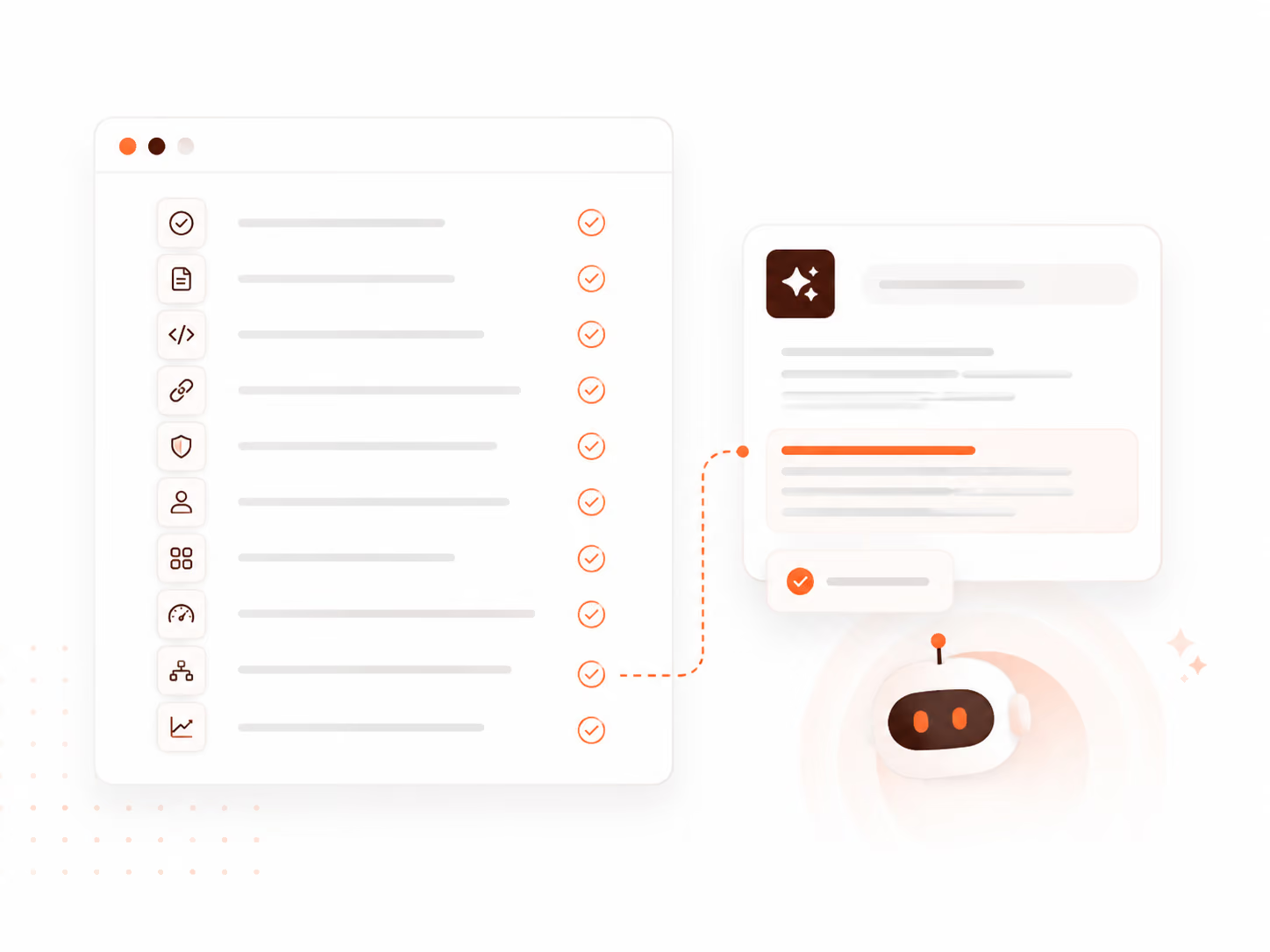
The 10-Point AEO Checklist
1. Your robots.txt Isn't Blocking AI Crawlers
If GPTBot, PerplexityBot, ClaudeBot, or Google-Extended can't crawl your site, nothing else on this list matters. Open your robots.txt file and confirm none of these are disallowed. This is a five-minute check that a surprising number of sites fail, usually because a developer blocked "bots" broadly at some point and never revisited the list.
2. Your Technical SEO Foundation Is Actually Solid
AEO sits on top of standard SEO, not instead of it. Clean sitemaps, correct canonical tags, HTTPS, fast load times, and mobile responsiveness aren't optional extras here, they're the layer everything else depends on. Roughly 70% of what makes a site AI-citable is still plain technical SEO. Skipping this step and jumping straight to schema markup is the most common mistake we see.
3. Key Pages Lead With a Direct, 40–60 Word Answer
Every important page should answer its own core question in the first 40 to 60 words beneath the heading, not three paragraphs in. AI engines extract the first sentence or two of a section to decide whether it resolves the prompt. A slow, scene-setting introduction gets skipped in favor of a competitor's page that gets to the point immediately.
4. Your Headings Are Phrased as Real Questions
Headings should match how someone actually asks the question, not how you'd label a slide. "Our Development Process" tells an AI engine nothing about what question it answers. "How long does a Webflow redesign take?" tells it exactly what to extract and when to surface it. Go through your top 10 pages and rewrite every H2 and H3 this way.
5. FAQ and Schema Markup Are Deployed and Validated
Structured JSON-LD schema is what turns your visually clear content into something a machine can parse with confidence. FAQ schema, Product/Rating schema where relevant, and Author schema on anything published under a named expert all belong here. Run every updated page through Google's Rich Results Test after deploying, since invalid schema is worse than none at all.
6. High-Value Pages Show a Visible "Last Updated" Date
A simple, visible freshness timestamp signals to AI crawlers that a page reflects current information, not something written two years ago and forgotten. Some analyses put the visibility advantage of demonstrated freshness at over 25%. It costs nothing to add and it's one of the few AEO signals you can control in under a minute.
7. Your Stats Are Specific, Not Vague
"Significant growth" tells an AI engine nothing it can cite. "142% increase in organic traffic" does. This is the Information Gain principle: search engines are actively deprioritizing generic, paraphrased content in favor of pages that bring something original to the conversation. Go through your key pages and replace every vague modifier with an exact number, even if that number is modest. Specificity beats hype every time.
8. You Have a Genuine, Disclosed Presence Where Your Buyers Actually Ask Questions
AI engines don't just read what your website says about you, they check what independent sources say too. Reddit in particular is heavily weighted by LLMs because its communities actively police spam and low-effort content. A handful of genuinely helpful, clearly disclosed answers in relevant threads does more for your AI visibility than most companies expect from such a small effort. The key word is disclosed: showing up as yourself, saying who you are, and actually solving the person's problem.
9. Your Help Center Is Structured, Not Buried
Support documentation is one of the most underused AEO assets most B2B companies have. It's already full of the exact direct-answer content AI engines are built to extract: "does your product support X," "how do I configure Y." If your help center lives on a separate subdomain, moving it to a subdirectory (yoursite.com/help/ instead of help.yoursite.com) pools that content's authority with the rest of your domain instead of isolating it.
10. You're Actually Tracking Whether Any of This Is Working
Without a baseline, you're guessing. Pick 5 to 10 real prompts your buyers would ask ("best [category] for [your target persona]" is a reliable starting template), run them across ChatGPT, Perplexity, and Gemini, and record whether your brand is mentioned, cited, or absent entirely. That's your Share of Voice baseline. Rerun it monthly. Without this step, you have no way of knowing whether items 1 through 9 actually moved anything.
How Many of These Should You Expect to Already Have?
Most B2B websites we audit pass 2 or 3 of these 10 items on the first check. That's not a criticism, it's simply because almost none of this existed as a discipline before AI search became a meaningful referral channel. The companies moving first on this list are the ones showing up in answers today, while everyone else is still optimizing purely for a results page fewer people are scrolling through.
Frequently Asked Questions
Do I need to do all 10 of these before I see any results? No, but items 1 and 2 are true prerequisites. An AI crawler that can't access your site or a site with a weak technical foundation will limit the impact of everything else on this list, regardless of order.
Which item on this list has the fastest turnaround? Checking your robots.txt and adding "Last Updated" dates can both be done in under an hour with no content work involved. The off-site presence and Share of Voice tracking items take longer since they require ongoing effort, not a one-time fix.
Can I do this checklist myself, or does it require an agency? Items 1, 2, 6, and 10 are straightforward enough for an in-house marketer or developer to handle directly. Items 3–5 and 7–9 benefit from experience since the details (word counts, schema types, which communities actually matter for your category) affect how well they work.
Is this checklist different for SaaS companies versus other B2B businesses? The ten items apply broadly, but the specifics change. A SaaS company's most valuable off-site presence is often different communities than a services firm's, and a SaaS help center typically has far more structured content to work with than a consulting firm's site does.
How often should I re-run this checklist? Treat items 1, 2, 5, and 6 as a one-time setup with a quarterly recheck. Items 8, 9, and 10 need ongoing attention since off-site consensus and Share of Voice both shift as competitors and AI engines themselves change.
If you've gone through this list and landed somewhere around 2 or 3 out of 10, that's the normal starting point, not a red flag. Book a Discovery Call and we'll run the full audit for you and show you exactly where the gaps are. You can also read our full breakdown of what AEO actually is and how the complete process works.
About the author: Jahid Aktar is the founder of Missing Piece Studio, a strategic web design agency for SaaS and B2B service companies. 80+ projects, 4+ years specializing in design psychology and conversion-focused Webflow builds.
Get a website built for growth
If your SaaS website is getting traffic but not converting visitors into trial users, it might be time to look at how your website is structured.
At Missing Piece Studio, we help SaaS companies design websites that clearly explain their product and drive more signups.