Why Your SaaS Website Doesn't Show Up in ChatGPT (And How to Fix It)

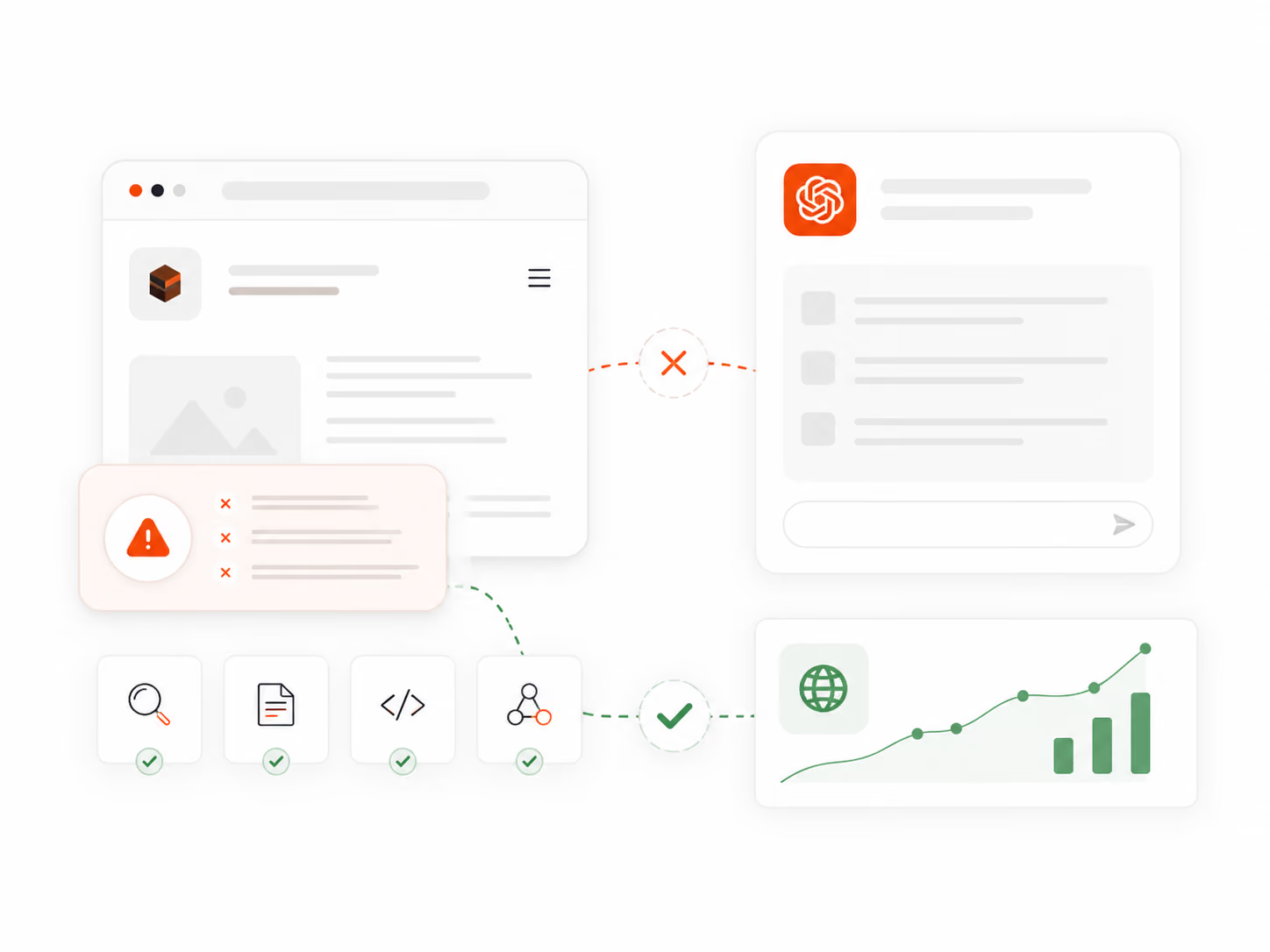
Why Doesn't Your SaaS Website Show Up in ChatGPT?
Your website doesn't show up in ChatGPT because AI engines don't rank pages the way Google does. They synthesize an answer from a small set of trusted sources, and if your site (or anyone talking about your site) isn't part of that set, you're invisible by default, not by penalty. There's no "AI SEO penalty" happening to you. There's just a system built on different rules than the ones most SaaS marketing teams have spent a decade optimizing for.
And that gap is bigger than most teams realize. AI-driven traffic to websites has grown roughly 9.7x over the past year, and monthly AI sessions now account for something like 56% of global search volume. A category your company used to compete for on a Google results page now has a second, largely unclaimed battlefield. Most competitors haven't even shown up to it yet.
Reason 1: Your Content Isn't Structured for AI to Extract
AI engines pull the first one to two sentences of a page section to check whether it directly answers a prompt, and most SaaS websites bury the actual answer under a paragraph of scene-setting first. If a visitor has to read three sentences of throat-clearing before getting to the point, an AI crawler has already moved on to a competitor's page that didn't make it wait.
This shows up constantly on SaaS marketing pages. A section titled "How does our platform handle onboarding?" that opens with "In today's fast-moving SaaS landscape, teams are increasingly focused on reducing time-to-value..." never actually answers the question in a form an AI engine can lift and quote. The fix is blunt: open every section with a direct 40 to 60 word answer, written the way you'd say it out loud to someone who just asked you the question. Then follow with supporting detail.
Reason 2: Nobody Else Is Talking About You
AI engines use Retrieval-Augmented Generation, or RAG, meaning they cross-reference what independent sources say about a brand before recommending it. A company with a great website but zero presence on Reddit, review sites, or industry forums often loses to a competitor with a worse website and five genuine mentions elsewhere. Your own homepage copy carries a lot less weight in this system than most marketing teams assume.
This is where the "volumetric mention rule" comes in. Appearing in five different cited sources across an AI-generated answer matters more than ranking #1 anywhere, because LLMs are synthesizing consensus, not crowning a single winner. Reddit specifically punches above its weight here. It shows up in AI answers at roughly 3.5 times the frequency you'd expect from a standard search results page, mostly because its communities actively self-police spam and AI engines have learned to trust that.
Reason 3: AI Crawlers Might Be Technically Blocked
Before assuming a content or strategy problem, check whether your robots.txt file is quietly blocking the crawlers that power AI search. A single misconfigured line can make an otherwise perfect page invisible to every AI engine at once. This is the fastest thing on this list to check and, honestly, the one most teams never think to look at.
Look specifically for GPTBot (OpenAI), PerplexityBot, Google-Extended (Gemini), and ClaudeBot (Anthropic). If any of these are disallowed, whether from an old privacy decision or a default CMS setting nobody remembers enabling, none of the content or off-site work below will matter. Five minutes to rule this out, before you do anything else.
Reason 4: Your Content Doesn't Say Anything New
AI engines increasingly favor Information Gain, content that adds something genuinely new to the web, over commodity content that repeats what a hundred other pages already say. A generic "what is customer onboarding" page competing against dozens of nearly identical explainers is unlikely to get cited no matter how well it's formatted. AI now writes about as much content as humans do, which means sameness costs you more than it used to.
Original proprietary statistics, first-person expert perspective, custom diagrams, and genuinely unique data pulled from your own product usage all count as Information Gain. If a stat is unique to your company, an AI engine effectively has to cite you as the source. There's nowhere else to pull it from.
How Do You Actually Check Where You Stand?
Run your own Brand Radar check: type the exact prompts a buyer would use into ChatGPT, Perplexity, and Gemini, and write down exactly who gets mentioned, who doesn't, and which sources each engine seems to be pulling from. Under an hour of work, and it gives you a real baseline instead of a guess.
A simple version:
- Write down the three to five phrases a real buyer would type, something like "best [your category] for [your ICP]"
- Run each one through ChatGPT, Perplexity, and Gemini
- Note whether you're mentioned at all, and if you are, which source the engine appears to be citing
- Repeat monthly and track the trend, not the single snapshot
We ran this exact check on our own site before writing this article, and we're publishing what we found, gaps included, rather than pretending we've already got it solved. Worth doing the same for your own brand before you decide what to fix first.
How Do You Actually Fix It?
Once you know which of the four problems you're dealing with, the fix maps back to the three-layer framework:
Most SaaS companies are dealing with two or three of these at once, not just one. That's exactly why a quick DIY fix rarely closes the gap on its own. Sequencing matters too: a blocked crawler makes every other fix pointless, so start there, then structure, then off-site presence.
Frequently Asked Questions
How do I know if my robots.txt is blocking AI crawlers? Open yourdomain.com/robots.txt directly in a browser and check for Disallow rules targeting GPTBot, PerplexityBot, Google-Extended, or ClaudeBot. If any of these are blocked and you didn't do it on purpose, that's probably your first and biggest fix.
Can a smaller SaaS company actually outrank an established competitor in AI search? Yes, and more realistically than in traditional Google rankings. AI engines weigh the volume of authentic, independent mentions across sources rather than raw domain authority, so a smaller company genuinely active on Reddit, review sites, and relevant forums can out-cite a bigger name that hasn't touched off-site presence yet.
Does fixing this require rebuilding our website? No. Three of the four reasons above (content structure, off-site presence, and crawler access) don't touch your site's design at all. The fourth, content depth, is a writing and research problem, not a redesign problem.
How long does it take to start showing up after making these fixes? Crawler and technical fixes can show up in your Brand Radar check within days, once AI engines re-crawl the page. Content structure and off-site consensus gains build over a few months of consistent effort, since they depend on AI engines accumulating enough independent signal to trust the recommendation.
Is it worth doing this ourselves, or does it need an agency? The Brand Radar check and the robots.txt audit are genuinely DIY, about fifteen minutes each. Structuring an entire site for AEO and building sustained off-site consensus across multiple platforms is where most internal marketing teams run out of time, not skill.
Not sure which of these four problems is actually holding your site back? Book a Discovery Call and we'll run the Brand Radar check on your brand live, across ChatGPT, Perplexity, and Gemini, and show you exactly where the gap is. Or see the full breakdown of our AEO/GEO process for how we fix it end to end.
About the author: Jahid Aktar is the founder of Missing Piece Studio, a strategic web design agency for SaaS and B2B service companies. 80+ projects, 4+ years specializing in design psychology and conversion-focused Webflow builds.
Get a website built for growth
If your SaaS website is getting traffic but not converting visitors into trial users, it might be time to look at how your website is structured.
At Missing Piece Studio, we help SaaS companies design websites that clearly explain their product and drive more signups.